
Summary of the Book of Romans: Righteousness Through Faith

Overview of Romans
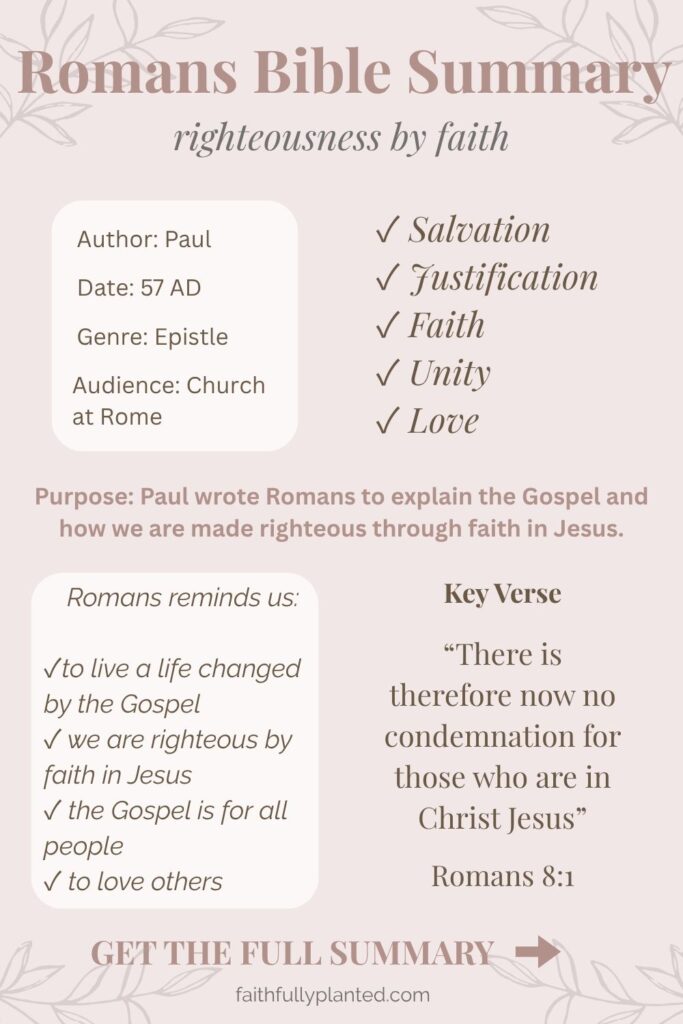
The Apostle Paul wrote Romans around AD 57, likely in Corinth near the end of his third missionary journey. Paul wrote to the church in Rome, which was predominantly Gentile but also included Jewish believers. There were many areas of disagreement between Jewish and Gentile Christians in this church, particularly regarding the Law, circumcision, food, and other religious practices.
Paul wrote to encourage them to pursue unity in Christ and to show that both Jews and Gentiles are saved by grace through faith in Jesus Christ. Paul writes to dissuade them from allowing cultural and religious differences to divide them and instead to live together as one body.
Romans lays out one of the clearest explanations of the Gospel in Scripture. Paul explains humanity’s problem with sin, God’s righteousness, justification through faith, freedom from sin, life through the Holy Spirit, God’s faithfulness to Israel, and what it looks like for believers to live transformed lives.
Romans is theologically rich and foundational for a solid understanding of the Gospel.
Let’s dive into the summary of the book of Romans!
Background
Who Should Read the Book of Romans?
Romans is the perfect book to read if you are:
- new to the faith and looking for solid theological foundations
- wanting to understand the Gospel on a deeper level
- wrestling with questions about sin, grace, and salvation
- wanting to understand how faith in Christ relates to the Old Testament Law
- studying what it means to live by the power of the Holy Spirit
- looking for encouragement about God’s faithfulness to His people
- seeking understanding about how the Gospel should shape your everyday life
Setting & Purpose
Setting: Paul wrote Romans to the church in Rome, a major city and center of the Roman Empire. At the time of the letter’s writing, Paul had not yet visited the church in Rome, although he deeply desired to do so. He planned to visit Rome on his way to Spain to continue spreading the Gospel.
Purpose: Paul wrote Romans to:
- Lay out his basic statement of the Gospel
- Explain humanity’s universal need for salvation
- Show that justification comes through faith in Jesus Christ rather than through works of the Law
- Explain God’s plan of salvation for both Jews and Gentiles
- Encourage Jewish and Gentile believers to live in unity
- Teach believers how the Gospel transforms the way they live
- Prepare the Roman church for Paul’s hoped-for visit and future missionary work
Key Themes in Romans
- Understanding that righteousness comes through faith in Jesus Christ rather than through our own works (1:16–17; 3:21–22; 4:1–8)
- Recognizing our need for salvation because all people have sinned and fallen short of God’s glory (1:18–32; 2:1–16; 3:9–23)
- Resting in God’s grace because we are justified by faith apart from works of the Law (3:24–28; 4:1–8; 5:1–2)
- Trusting in Jesus Christ as the source and means of our salvation (3:21–26; 5:6–11; 10:9–13)
- Living a new life in Christ through our union with His death and resurrection (6:3–11; 7:4; 8:10–11)
- Walking in freedom from sin rather than continuing as its slaves (6:6–14; 6:17–18; 6:22)
- Living by the power of the Holy Spirit who gives us life and enables us to live for God (8:1–14; 8:26–27)
- Trusting God’s faithfulness to His promises and His purposes (4:20–21; 9:6–16; 11:1–2, 28–29)
- Embracing the Gospel for all people because salvation is through faith (1:16; 3:29–30; 10:11–13; 11:11–24)
- Offering our lives to God as living sacrifices, allowing Him to transform us by renewing our minds (12:1–2; 12:9–21)
- Pursuing unity with other believers (14:1–19; 15:1–7)
- Loving and serving others because love fulfills the Law (12:9–10; 13:8–10; 14:15; 15:1–2)
Key Verses in Romans
Main Idea Verse: “Therefore, there is now no condemnation for those who are in Christ Jesus, 2 because through Christ Jesus the law of the Spirit who gives life has set you[a] free from the law of sin and death.”
Romans 8:1-2
Romans 3:23 — “For all have sinned and fall short of the glory of God.”
Romans 5:8 — “But God demonstrates his own love for us in this: While we were still sinners, Christ died for us.”
Romans 6:23 — “For the wages of sin is death, but the gift of God is eternal life in Christ Jesus our Lord.”
Romans 10:9 — “If you declare with your mouth, ‘Jesus is Lord,’ and believe in your heart that God raised him from the dead, you will be saved.”
Romans Chapter Breakdown
- The Gospel and the Righteousness of God — Paul introduces himself, expresses his desire to visit Rome, and declares that the Gospel reveals God’s righteousness through faith (1:1–17)
- Humanity’s Need for the Gospel — Paul explains God’s judgment against sin and shows that both Gentiles and Jews are accountable to God (1:18–3:20)
- Righteousness Through Faith in Christ — Paul reveals God’s plan to make sinners righteous through faith in Jesus and uses Abraham as an example of justification by faith (3:21–4:25)
- Peace With God and New Life in Christ — Those who are justified by faith have peace with God, and through Christ they receive freedom from sin and new life (5:1–8:39)
- God’s Faithfulness to Israel — Paul wrestles with Israel’s unbelief and explains God’s sovereign plan for salvation, including both Jews and Gentiles (9:1–11:36)
- Living as a Transformed People — Paul calls believers to offer themselves to God, live in love and holiness, submit to governing authorities, and pursue unity within the body of Christ (12:1–15:13)
- Paul’s Mission and Ministry — Paul explains his calling to preach the Gospel among the Gentiles, shares his plans to visit Rome and Spain, and asks for prayer (15:14–33)
- Greetings, Warnings, and Final Praise — Paul greets fellow believers, warns the church against those who cause division, and closes by praising God for the Gospel (16:1–27)
Romans in the Story of Scripture
Romans connects the story of salvation throughout Scripture. The Old Testament reveals humanity’s sin, God’s holiness, His covenant promises, and His plan to bless the nations. Romans shows how those promises find their fulfillment in Jesus Christ.
Paul demonstrates that the Gospel is not a new plan that replaced God’s previous work. Instead, salvation through faith in Christ is consistent with God’s work throughout Scripture. Abraham was justified by faith, the Law revealed humanity’s need for a Savior, and God’s promises to Israel remain part of His unfolding plan.
Through Jesus, salvation extends to both Jew and Gentile. The Gospel creates a new people who are united not by ethnicity, religious background, or personal achievement, but by faith in Christ.
What the Book of Romans Teaches Us About God
- God is righteous: God is perfectly holy and just. He does not overlook sin, but He provides a way for sinners to be made righteous through Christ.
- God is merciful: Although humanity deserves judgment because of sin, God offers salvation as a gift through Jesus
- God is faithful: God does not abandon His promises. Romans reminds us that God’s purposes cannot be thwarted and that He remains faithful to His people.
- God saves: Salvation is ultimately God’s work. We cannot earn righteousness through our own goodness or religious accomplishments.
- God is sovereign: Romans reminds us that God is wise and sovereign even when we do not fully understand His plans.
- God loves us: God demonstrated His love by sending Christ to die for sinners. Nothing can separate those who belong to Christ from God’s love.
What the Book of Romans Teaches Us Today
Romans gives us a deep understanding of the Gospel, but it also shows us how the Gospel should change the way we live.
We don’t have to earn anything by our works, though they naturally overflow from a changed heart. We are made right with God through faith in Jesus Christ. Our obedience is a response to the grace we have already received.
Romans also reminds us that we are no longer slaves to sin. Because we belong to Christ and have the Holy Spirit living within us, we can live with unity, peace, and freedom.
The Gospel presented in Romans also reminds us that our lives should look different to other people in how we act and how we treat others. We are called to love others, serve one another, pursue peace, and refuse to let secondary disagreements divide the body of Christ.
Ultimately, Romans calls us to surrender our entire lives to God—to become living sacrifices who are transformed by the renewing of our minds and who use what God has given us to serve others.
Want to Study Romans More?
If you’d like a visual overview of the Book of Romans, I also recommend watching BibleProject’s excellent video summary of Romans. Their animation provides helpful context and highlights how the themes of the letter fit into the larger story of Scripture.
Whether you are reading through James for the first time or studying it more deeply, I hope this overview helps you better understand its message and encourages you to grow in your walk with Christ.
Download the Printable Book of Romans Summary
Want to keep this overview handy as you study through Romans?
I’ve created a beautiful 2-page printable Book of Romans Summary PDF that includes the key themes, setting, outline, key verses, what James teaches us about God, and practical application—all in an easy-to-reference format that’s perfect for your Bible study binder or digital notebook.
Grab yours below!
Want to Study Romans More Deeply?
If this overview has made you want to dig deeper into Romans, the Faithfully Planted Book Study Pack can help you study it for yourself.
The guided pages are designed to help you slow down, study Scripture, take notes, reflect on what you’re learning, and apply God’s Word to your life. And while it’s perfect for studying Romans, you can use the same study pack to work through any book of the Bible.
Inside the Book Study Pack you’ll find:
- Book Study Notes
- Chapter Study Log
- Chapter Study Notes
- Book Reflection Notes

Grab your Bible, download the Book Study Pack, and start studying Romans for yourself.
I pray this blesses you and helps you to learn more about God through His Word!
Your Sister in Christ,